> For the complete documentation index, see [llms.txt](https://docs.veza.com/4yItIzMvkpAvMVFAamTf/llms.txt). Markdown versions of documentation pages are available by appending `.md` to page URLs; this page is available as [Markdown](https://docs.veza.com/4yItIzMvkpAvMVFAamTf/getting-started-with-veza.md).

# Getting Started

Welcome to Veza, your unified access control platform for data governance, data access management, cloud entitlements, privileged access, and much more.

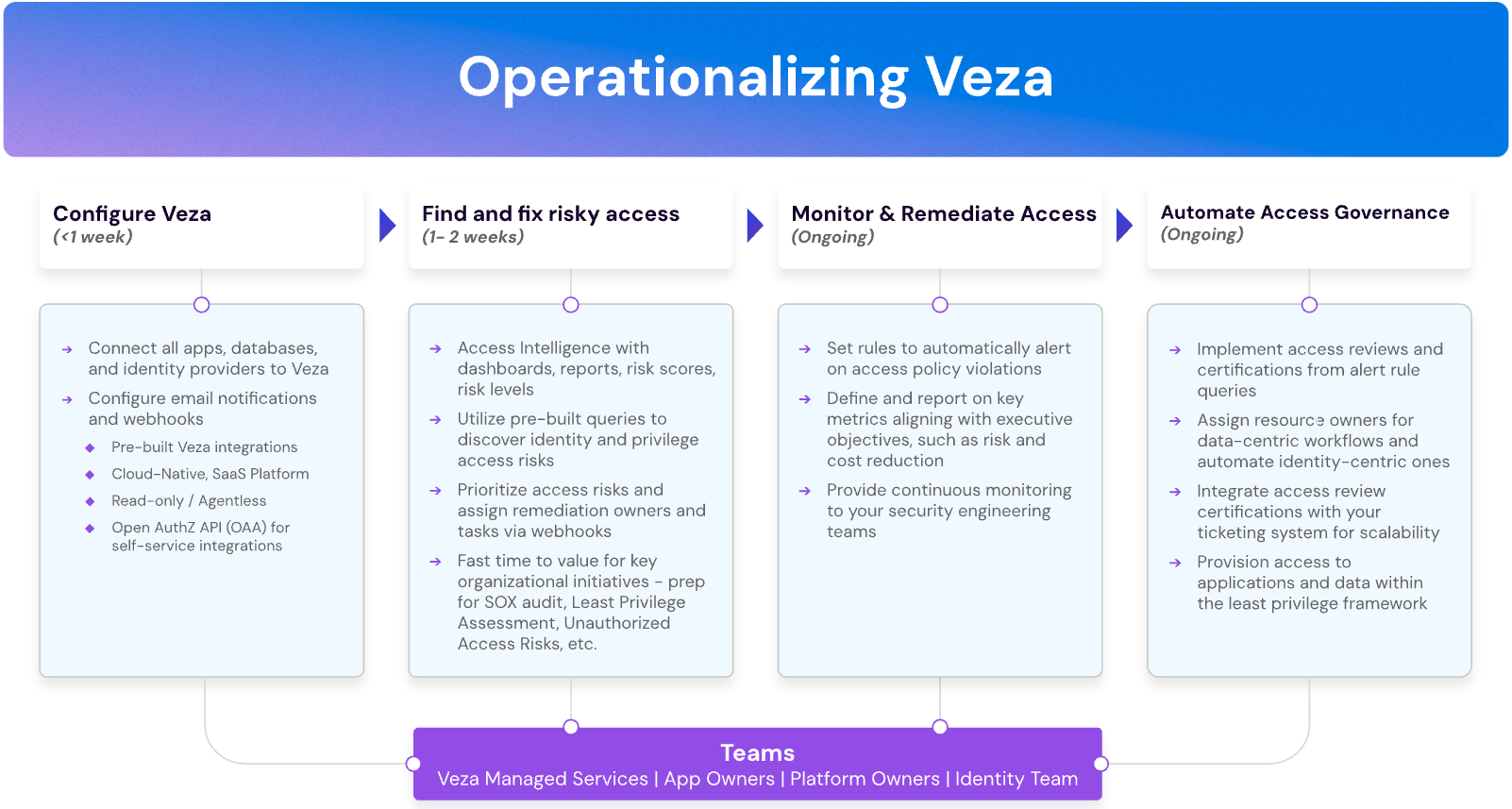
This page introduces important features to help you implement and operationalize Veza for your organization and teams. You will learn how to enable external integrations and begin leveraging Access Intelligence, Access Search, and Access Reviews.

<figure><img src="/files/2ek0XhzkVB3mvpUSgrPr" alt=""><figcaption></figcaption></figure>

See the following sections for details:

* [#configure-veza-to-discover-enterprise-resources](#configure-veza-to-discover-enterprise-resources "mention")
* [#explore-your-entity-catalog](#explore-your-entity-catalog "mention")
* [#leverage-built-in-and-customized-access-intelligence](#leverage-built-in-and-customized-access-intelligence "mention")
* [#search-and-query-for-who-has-access-to-any-resource](#search-and-query-for-who-has-access-to-any-resource "mention")
* [#conduct-ongoing-access-reviews](#conduct-ongoing-access-reviews "mention")
* [#secure-non-human-identities](#secure-non-human-identities "mention")
* [#operationalize-veza-for-your-users-and-teams](#operationalize-veza-for-your-users-and-teams "mention")

### Configure Veza to discover enterprise resources

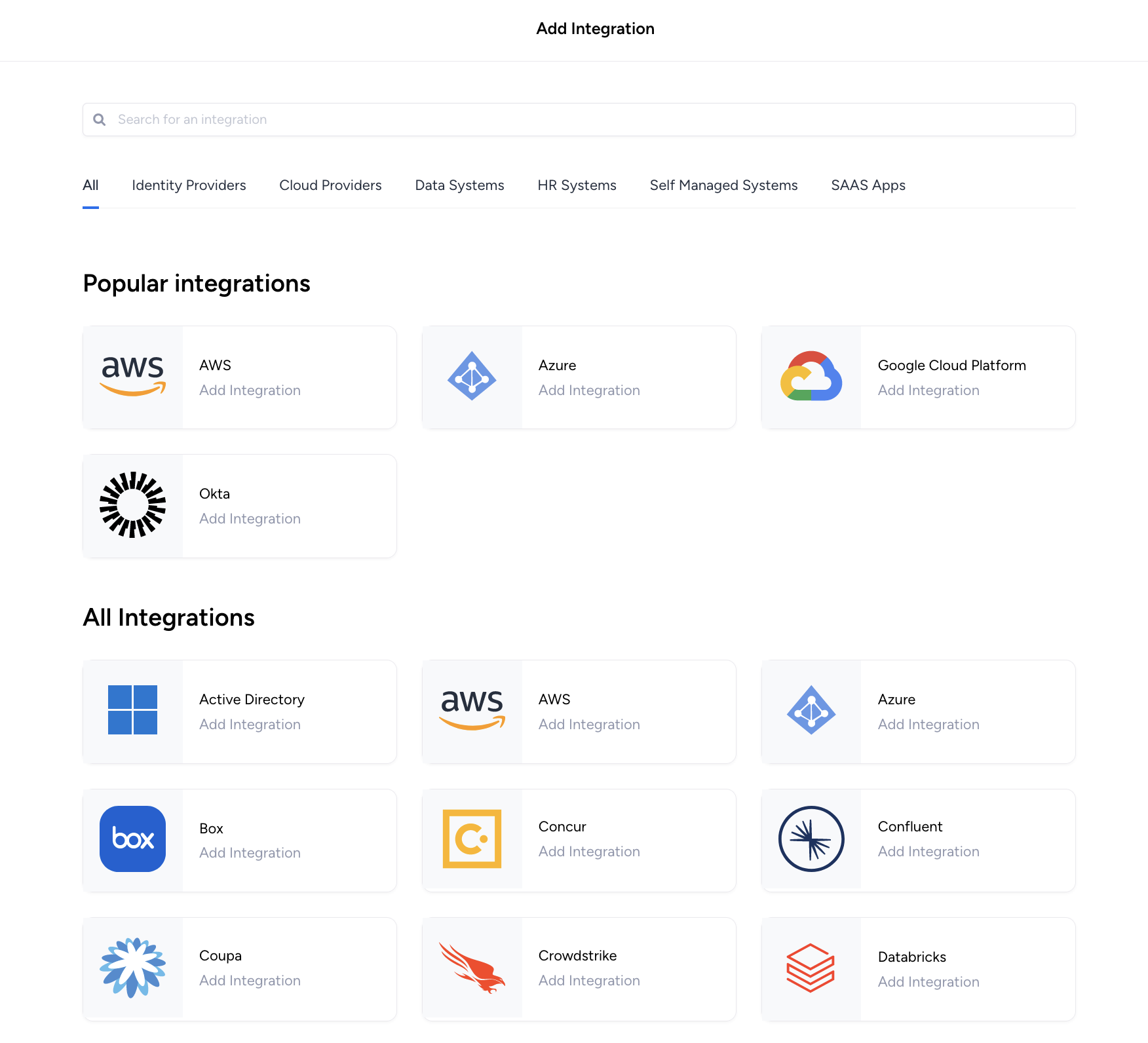
To fully make use of Veza, you will need to integrate the Identity, Cloud, and application providers used by your organization. Veza periodically connects to these application providers and data sources to populate the Access Graph and gather entity metadata.

<figure><img src="/files/UZhkskEfJYxhgwYpALRo" alt=""><figcaption><p>The Integrations page shows all configuration details, with the option to add new integrations or manage existing ones.</p></figcaption></figure>

To add integrations, open **Integrations** and click **Add Integration**. For more details, see [Veza Integrations](/4yItIzMvkpAvMVFAamTf/integrations/integrations-overview.md) and [Configuring Integrations](/4yItIzMvkpAvMVFAamTf/integrations/configuration.md). You can learn more about the requirements for each integration in the related setup guide.

<table data-view="cards" data-full-width="true"><thead><tr><th></th><th></th><th></th></tr></thead><tbody><tr><td><strong>Identity Providers</strong></td><td>Configure the services used by your organization for identity management and authentication:</td><td><ul><li><a href="/pages/taep5tNH8k2AuhOjd8lN">Okta</a></li><li><a href="/pages/5rjG9dxnzHTdD5rS9z5s">Azure AD</a></li><li><a href="/pages/ADGdzGqadpksFukJYaGj">Google Workspace</a></li></ul></td></tr><tr><td><strong>Cloud Providers</strong></td><td>Configure your organizations cloud providers to discover identities, services, and resources:</td><td><ul><li><a href="/pages/xMcA5X9IvYeMWbwsuMbY">Amazon Web Services</a></li><li><a href="/pages/ADGdzGqadpksFukJYaGj">Google Cloud Platform</a></li><li><a href="/pages/aoLYCJHULKLiijvxccRJ">Microsoft Azure</a></li></ul></td></tr><tr><td><strong>Apps and Data Systems</strong></td><td>Integrate additional applications with built-in connectors, or Open Authorization API (OAA) for custom data sources:</td><td><ul><li><a href="/pages/Kgsbvu67dQNk8E0Y51xw">Supported integrations</a></li><li><a href="/pages/7sJzcFl5BQpylv7cO3rR">Open Authorization API</a></li></ul></td></tr></tbody></table>

### Explore your entity catalog

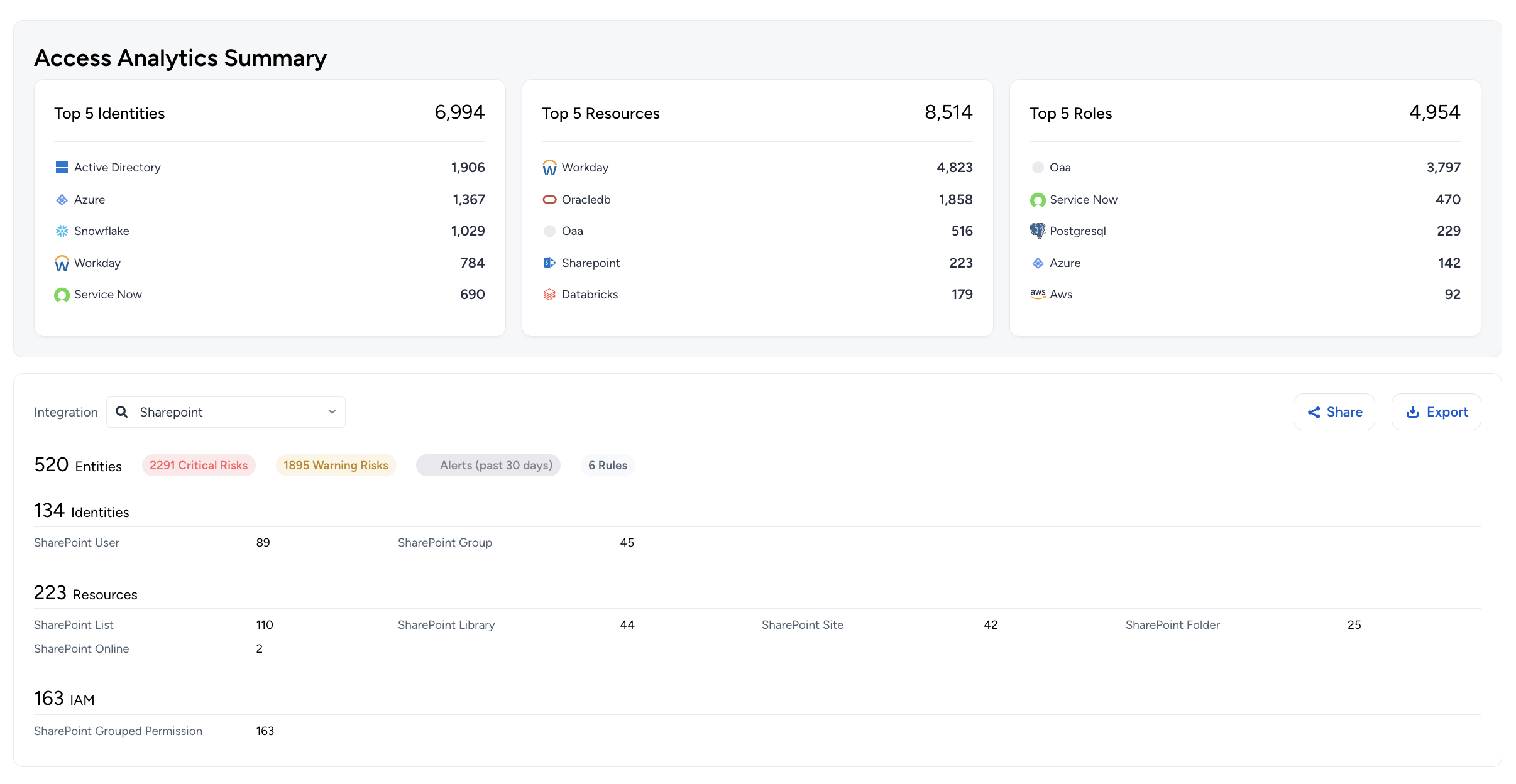
Veza builds a catalog of all your entities across identity providers, cloud providers, apps, and data systems. You can review all of these on the **Dashboards** > **Home** page. Choose data sources from the menu to view all the entity types Veza has discovered, and click an entity type to bring up a list of those entities in the **Query Builder**, where you can view additional attributes and details.

<figure><img src="/files/6vtPGcOyvPY50AISedxq" alt=""><figcaption><p>The Analytics page shows all the systems and resources Veza has discovered.</p></figcaption></figure>

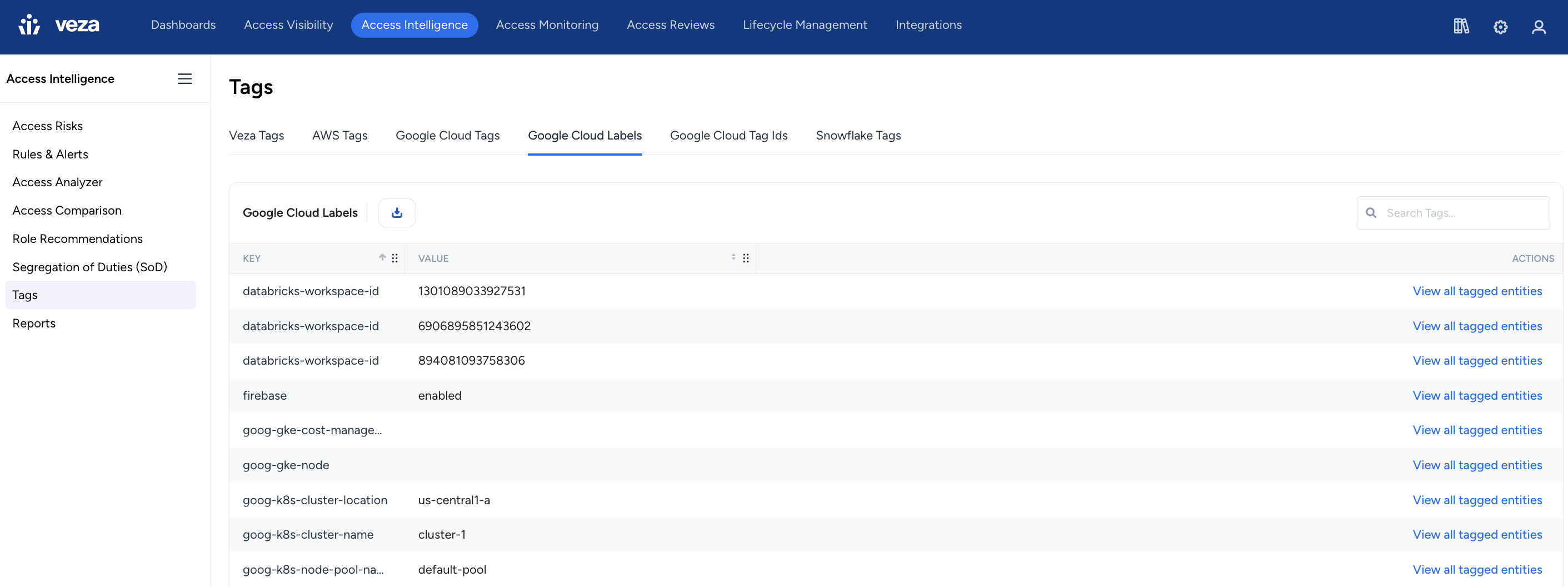
The metadata Veza discovers includes **Tags** from cloud providers (such as AWS tags or GCP labels) You can also create and apply Veza tags to identify sensitive cloud data assets across multiple providers and applications. Open **Access Intelligence** > **Tags** to see the tags Veza has already discovered.

<figure><img src="/files/6wSkV0tutTRLc3Rdgvcb" alt=""><figcaption><p>The Tags page includes tabs for each type of tag supported by Veza.</p></figcaption></figure>

### Leverage built-in and customized Access Intelligence

Veza ships with hundreds of out-of-the-box assessment queries to provide rapid insight into risks, anomalies, and the overall state of authorization within integrated systems.

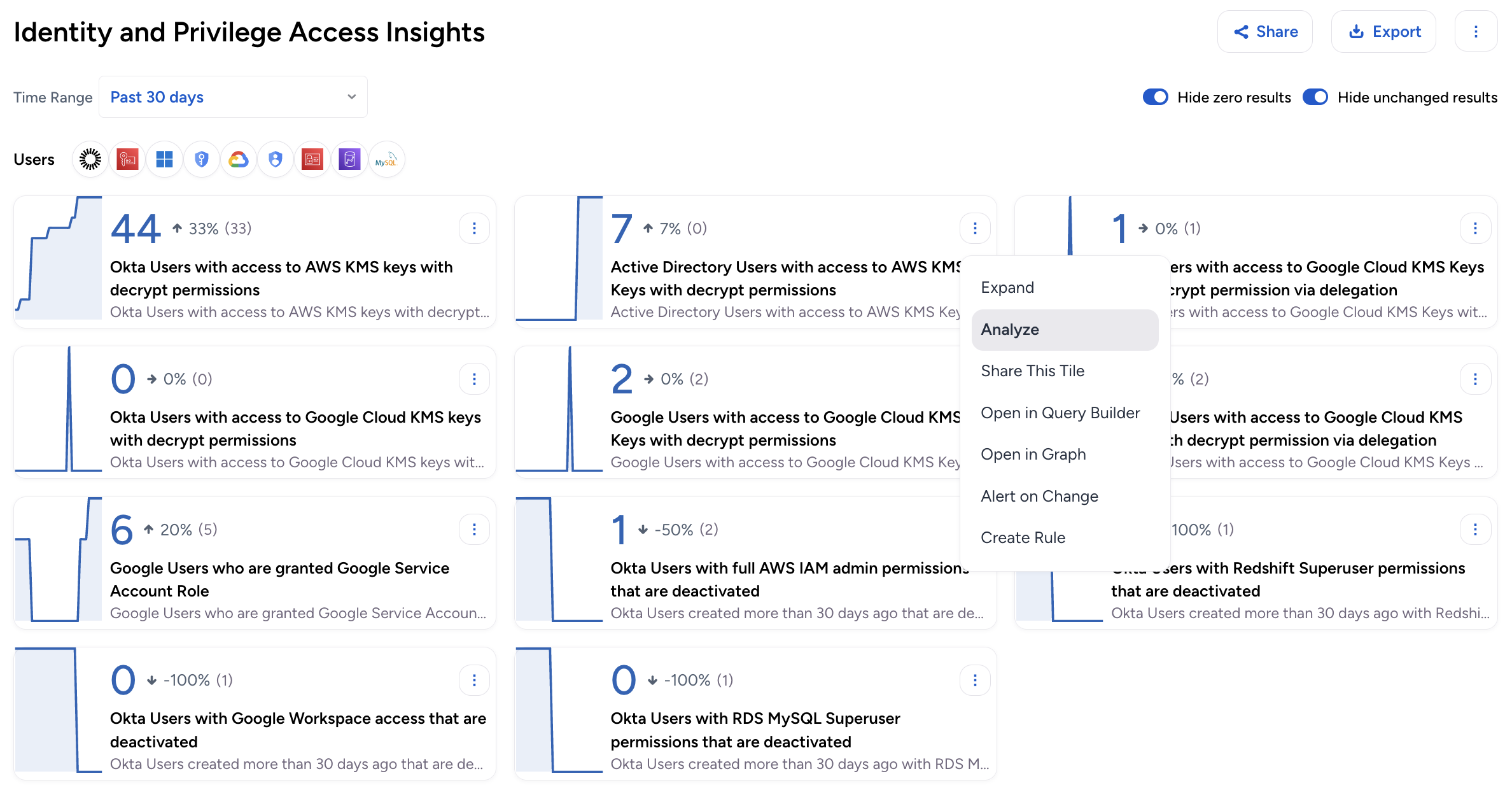
The main **Dashboards** page showcases some of these top risks and important insights, with the option to open any query to inspect the detailed results. Use **Dashboards** to review built-in and custom dashboards. Then, try creating a custom dashboard to capture data access trends and track risks for your organization.

<figure><img src="/files/clcG1Y80rOhvJHpl7Ugx" alt=""><figcaption><p>Dashboards show time-series-based assessments for identity analysis, privilege access, and data access.</p></figcaption></figure>

See the [Insights](/4yItIzMvkpAvMVFAamTf/features/insights.md) overview for more information about **Risks**, **Rules**, and the **Analysis** section.

### Search and query for who has access to any resource

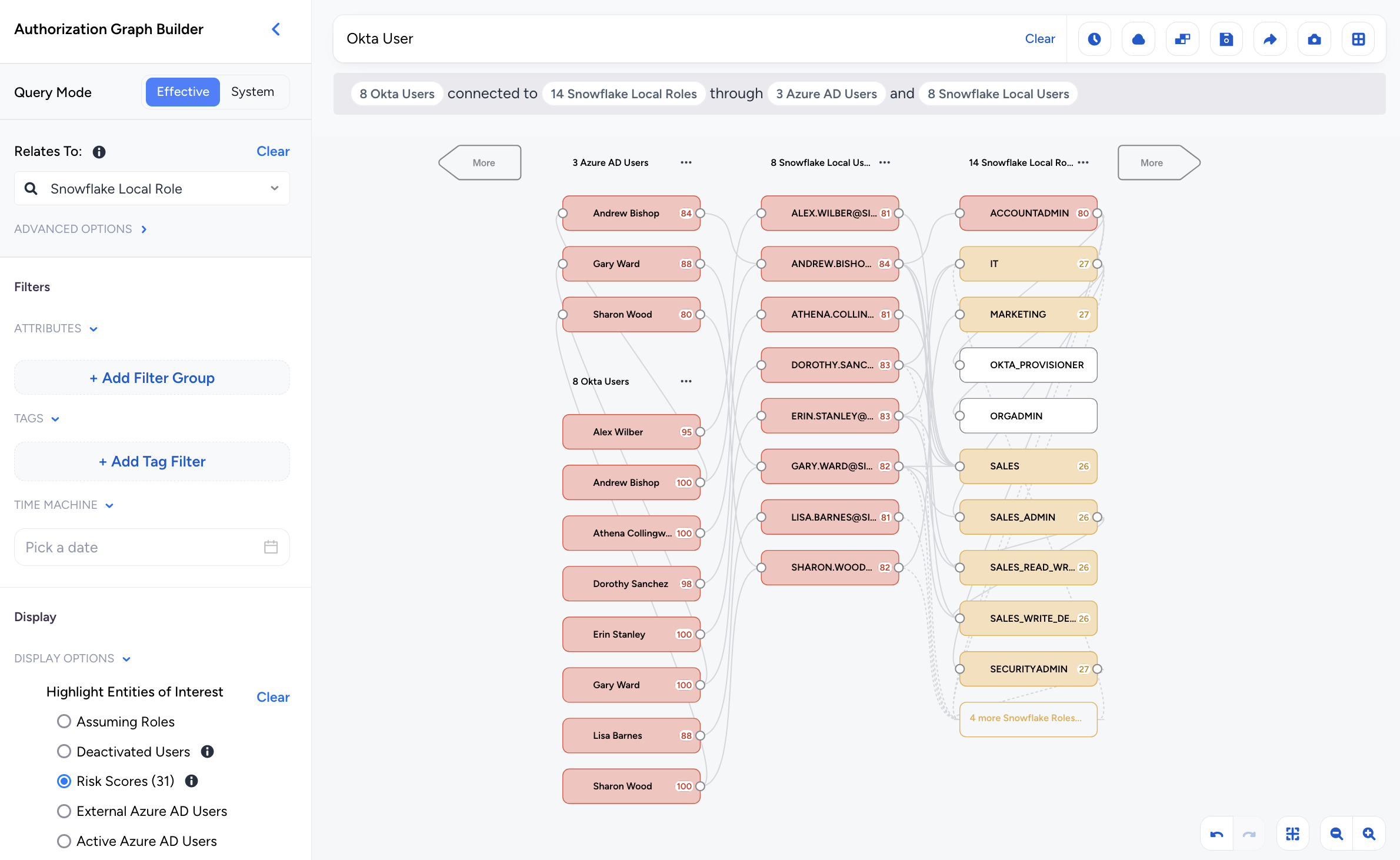
Veza discovers the connections between entities in the Access Graph and makes these relationships searchable with a visual **Graph** search and flexible **Query Builder**.

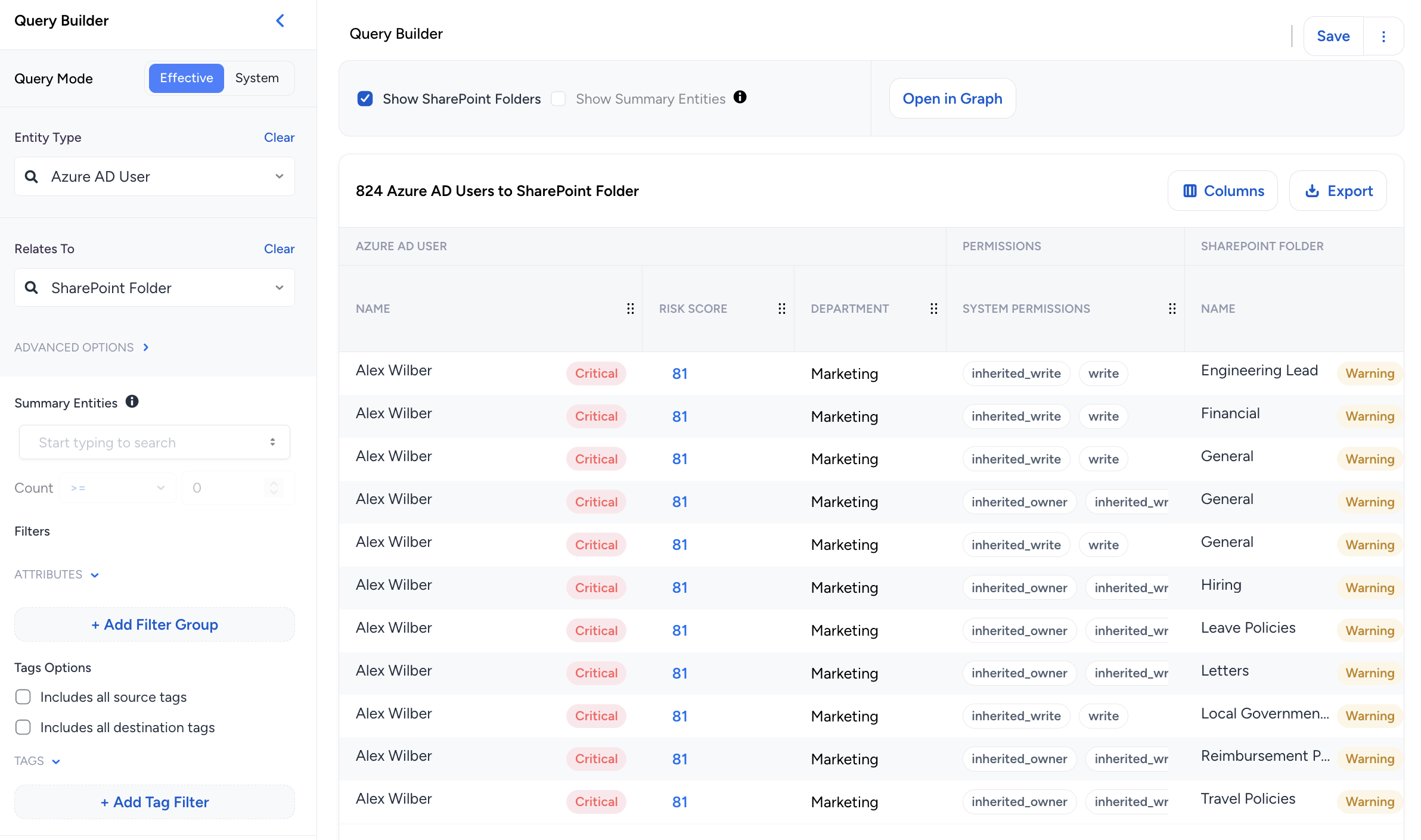
You can use these **Access Visibility** features to explore the different types of entities in the Data Catalog. To get started, go to **Access Visibility** > **Queries**, and try opening some out-of-the-box assessments in the Query Builder to fine-tune them based on your organization's priorities and unique environments.

<figure><img src="/files/MbXgUo83xn1tBNkSdwCN" alt=""><figcaption><p>The Query Builder shows relationships between entities in a tabular, exportable format.</p></figcaption></figure>

* Search for a single entity (such as an Okta User or Snowflake Database) using the **Graph** search bar to show all the connections Veza has found.
* Specify a *source* and *destination* entity in **Query Builder** to find all entities of the *source* type with a relationship to entities of the *destination* type.
* Apply filters on any of the entity attributes Veza has discovered to narrow your search using rich metadata such as user `department`, `manager`, or `last activity date`.

<figure><img src="/files/ROyoj7PJfim93z0OdRg5" alt=""><figcaption><p>Graph search enables you to explore relationships between entities, with risk highlighting and advanced visualization options.</p></figcaption></figure>

See the [Search](/4yItIzMvkpAvMVFAamTf/features/search.md) overview for more information about the Graph and Query Builder search interfaces.

### Conduct ongoing Access Reviews

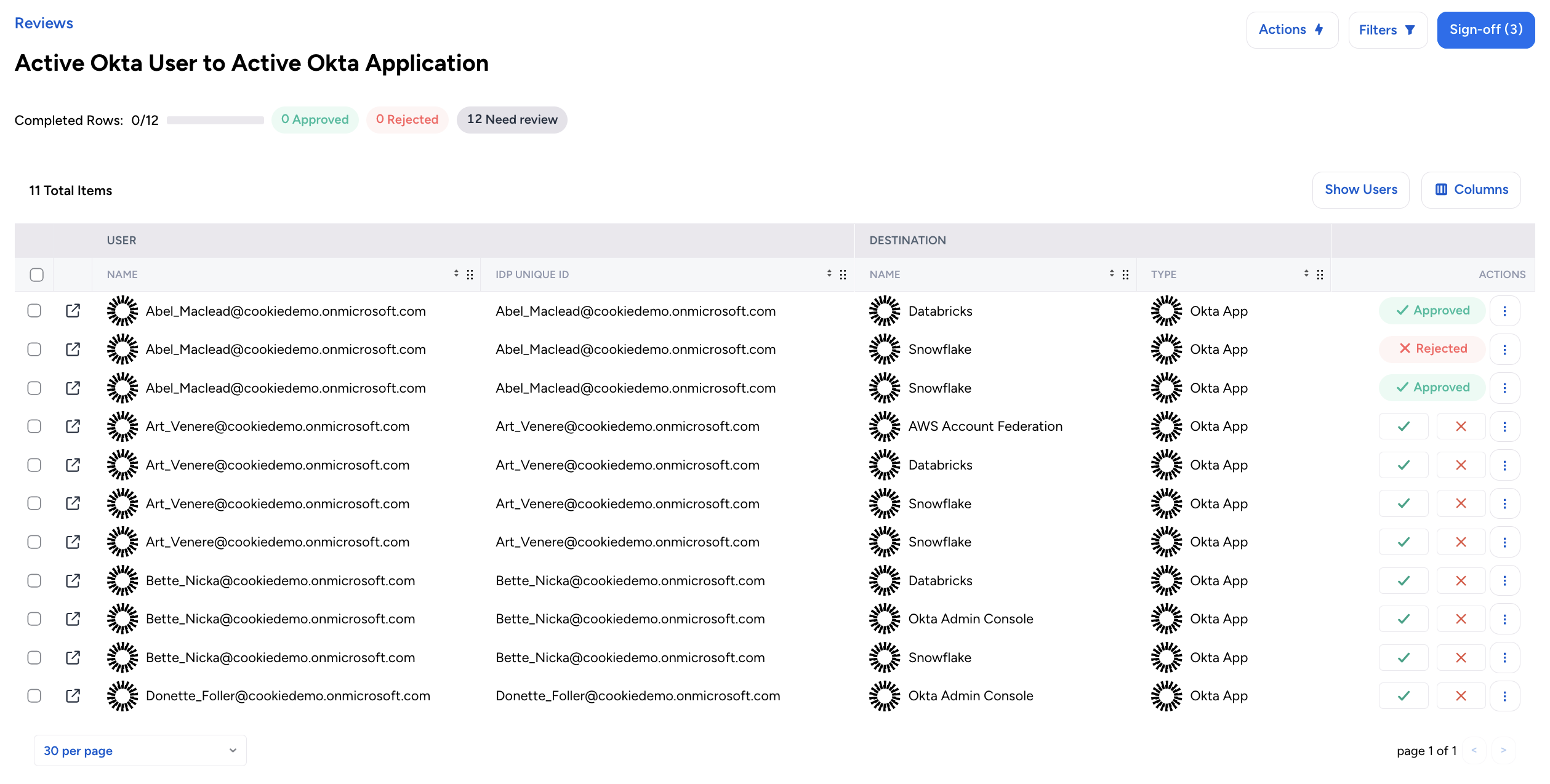
Veza **Access Reviews** enable repeatable, granular, and integrated certification campaigns. These can be conducted by a single auditor, or involve collaborators automatically assigned from many departments and teams. Open **Access Reviews** to create and manage configurations for user access reviews, privileged access reviews, entitlement management, role management, identity lifecycle, and more.

<figure><img src="/files/R6to2Uszu2couYKuQEYh" alt=""><figcaption></figcaption></figure>

* Depending on the business and compliance requirements, Access Reviews can audit user access to data, resource entitlements, roles, groups, and policies, or any other *source* -> *destination* relationship discovered by Veza.
* After creating a configuration that defines the scope of a review, administrators and operators can create and schedule new reviews, and assign each result row to individual managers or resource managers for review and attestation.

See [Access Reviews](/4yItIzMvkpAvMVFAamTf/features/access-reviews.md) for more information about creating a Workflow and starting and reviewing Certifications.

### Secure non-human identities

Veza [NHI Security](/4yItIzMvkpAvMVFAamTf/features/nhi.md) provides comprehensive visibility and governance for service accounts, API keys, and automated systems. Organizations typically have 10-45 non-human identity (NHI) accounts per human user, making this a critical area for security coverage.

* Navigate to **NHI Security > Overview** to assess your current NHI landscape and identify priority areas.
* Assign owners to critical NHI accounts and establish accountability for service account governance.
* Use NHI-specific saved queries and [VQL](/4yItIzMvkpAvMVFAamTf/features/search/vql.md) to identify high-risk patterns such as unowned accounts with admin privileges, dormant credentials, and cross-account access.
* Set up [Rules and Alerts](/4yItIzMvkpAvMVFAamTf/features/insights/rules-and-alerts.md) and [Access Reviews](/4yItIzMvkpAvMVFAamTf/features/access-reviews.md) scoped to NHI accounts for ongoing governance.

For organizations managing AI agents and workload identities, see [Access AI](/4yItIzMvkpAvMVFAamTf/features/access-ai.md) for generative AI capabilities that extend NHI visibility with natural language queries and intelligent risk detection.

### Operationalize Veza for your users and teams

Veza is designed to support collaboration between users and teams and integrate with external systems and workflows. Once you've familiarized yourself with the platform, you can invite your team, enable outbound actions and alerts, and enable advanced functionality:

* Configure [notifications](/4yItIzMvkpAvMVFAamTf/administration/administration/notifications.md) in other enterprise apps such as Jira, Slack, and ServiceNow.
* Enable [SAML Single Sign On](/4yItIzMvkpAvMVFAamTf/administration/administration/sign-in-settings.md) for your identity provider.
* [Invite and manage users](/4yItIzMvkpAvMVFAamTf/administration/administration/users.md) and create [teams for role-based access control](/4yItIzMvkpAvMVFAamTf/administration/administration/users/teams.md).
* Create [Alert Rules](/4yItIzMvkpAvMVFAamTf/features/insights/rules-and-alerts.md) to get notifications when thresholds and conditions are met.
* Configure [Veza Actions](/4yItIzMvkpAvMVFAamTf/administration/administration/notifications.md) to remediate risk findings by automatically creating Jira tickets, ServiceNow incidents, or Slack alerts when rules trigger.
* Explore and customize [administrative settings for Access Reviews](/4yItIzMvkpAvMVFAamTf/features/access-reviews/configuration/access-review-settings.md).
* Explore [Veza APIs and developer documentation](/4yItIzMvkpAvMVFAamTf/developers/api.md).
* Enable [Activity Monitoring](/4yItIzMvkpAvMVFAamTf/features/activity-monitoring.md) for supported integrations.
* Enable [Access AI](/4yItIzMvkpAvMVFAamTf/features/access-ai.md) for natural language queries, semantic search, and AI-powered risk detection across your environment.


---

# Agent Instructions
This documentation is published with GitBook. GitBook is the documentation platform designed so that both humans and AI agents can read, navigate, and reason over technical content effectively. Learn more at gitbook.com.

## Querying This Documentation
If you need additional information that is not directly available in this page, you can query the documentation dynamically by asking a question.

Perform an HTTP GET request on the current page URL with the `ask` query parameter:

```
GET https://docs.veza.com/4yItIzMvkpAvMVFAamTf/getting-started-with-veza.md?ask=<question>
```

The question should be specific, self-contained, and written in natural language.
The response will contain a direct answer to the question and relevant excerpts and sources from the documentation.

Use this mechanism when the answer is not explicitly present in the current page, you need clarification or additional context, or you want to retrieve related documentation sections.